
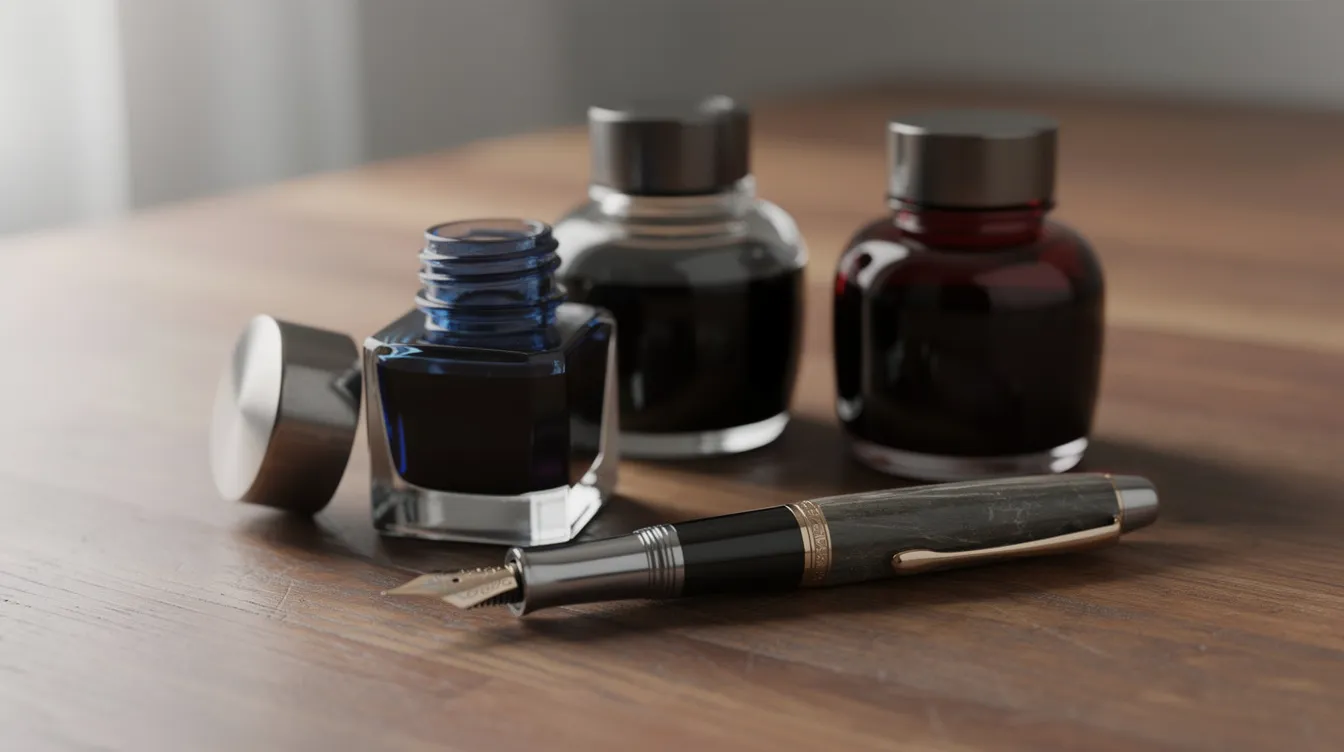
What is the best ink for a fountain pen when sketching?
Four years ago I bought a cheap fountain pen and a pocket sketchbook for a weekend in Galway. The pen cost less than lunch. The ink that came with it was a standard blue cartridge, and it worked fine until I touched a wet brush to a harbour wall drawing and watched the whole thing bleed into a pale puddle. That moment taught me more about fountain pen inks than a month of reading ever could.
Choosing Fountain Pen Ink for Urban Sketching
Why I Use Fountain Pen Ink for Sketching
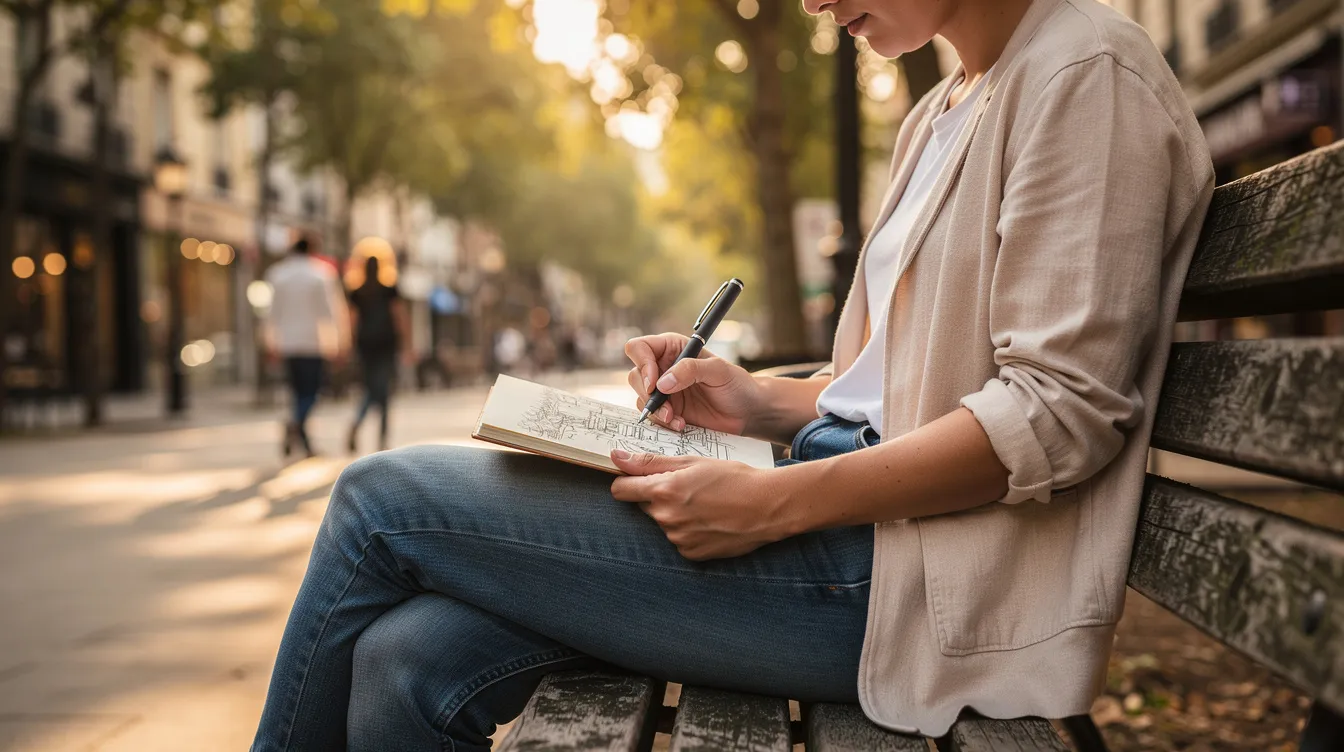
I am a school caretaker in Cork. I have about thirty-five minutes for lunch, and I spend twenty of them on a bench with a sketchbook on my knee. Everything I know about ink for a fountain pen comes from smudged pages, not from a classroom. I am not an expert. I am someone who draws shopfronts and bus stops and has ruined enough sketches to have opinions.
If you are still working out what you want from a sketchbook, that is fine. Sketching, the way I mean it, is drawing the places around you quickly and simply, with whatever you have in your pocket. The ink you fill your pen with decides whether those lines survive a splash, a wash of watercolour, or even a damp afternoon in Cork. If you want more on that, read what sketching actually means.
How I Choose Fountain Pen Inks
My rule is simple. If you only buy one bottle, buy a waterproof black ink. Colour can come later. Dye-based inks are the most common and versatile type for fountain pens, and they are typically easy to clean out of a pen. But most of them wash away the moment water touches them, and that limits what you can do with a sketch afterwards.
Fountain pen inks vary widely by their chemical base and visual characteristics. They are grouped based on their special visual effects and chemical bases. Understanding flow, shading, sheen, shimmer, drying time, and water resistance aids in ink selection, but you do not need to master all of that on day one. Wet inks lubricate nibs and provide smooth writing experiences, which matters when you are drawing quickly. A reliable fountain pen with a fine or medium nib is plenty. A fine nib lays down less ink, so lines dry faster and feather less. A medium nib gives a slightly bolder mark. I use both depending on the subject.
Test samples before buying full bottles. Most shops that stock fountain pen ink bottles will sell small vials, and a 2ml sample tells you everything a product photo cannot.
Bottled Ink Versus Cartridges
Bottled ink suits regular sketchers because the cost per fill is lower and the range of formulations is enormous. The product type bottled ink gives you access to waterproof pigments, iron gall recipes and specialty inks that rarely come in cartridge form. I fill my converter with a syringe from a small bottle I keep on my desk at home.
Ink cartridges are better for a lightweight travel kit. They are sealed, they do not leak, and you can drop a spare in your pocket. Waterman inks come in reliable cartridges with standard colors that fit many pens. When I travel light, I carry two cartridges and leave the bottles behind.
Finding the Right Fountain Pen Ink Colour
Waterproof black, such as Platinum Carbon Black, is my dependable base. From there I add one or two colours depending on my mood and the scene.
Here is how I think about colour for sketching:
|
Colour |
Use |
Example |
|---|---|---|
|
Black |
Strong outlines, focal details |
Platinum Carbon Black |
|
Blue black |
Everyday outlines, softer than pure black |
Diamine Registrar’s |
|
Dark blue |
Architecture, sky reflections |
Pilot Iroshizuku Asa-gao, a bright royal blue |
|
Brown |
Warm architectural lines, brick, wood |
Rohrer and Klingner Sepia |
|
Grey |
Bench shadows, distant buildings |
Any light grey dye ink |
|
Green |
Foliage accents |
Sparingly, from a dye ink |
Dye-based inks are best for everyday writing due to their excellent color variety. Special effects inks can feature shading, sheening, and shimmer. Sheening inks produce a secondary color visible in reflected light, which looks striking on paper but is not always practical for sketching. Pigment-based inks are more limited in color options than dye-based inks, so most of my colour bottles are dye.
Ink manufacturers focus on durability against time and light, which matters if you want a sketchbook to last years. Some inks are designed to create visual effects while others focus on permanence. For sketching, I lean toward permanence.
Ordinary dye inks have lovely colours. I sometimes touch a wet brush to a dye line on purpose for a soft shadow. That is a deliberate choice, not a mistake. But if I plan to paint over a drawing, I need lines that stay put.
Lamy Black ink has a purple cast when dried, which surprised me the first time. Montblanc Burgundy Red is a consistently good performer if you want a red for highlights. Kaweco offers vibrant and low maintenance fountain pen inks in a useful range of tones. Pilot Iroshizuku Asa-gao is a bright royal blue ink that shades beautifully. You will also find interesting formulations from Ferris Wheel Press, Lennon Tool Bar, and De Atramentis, and luxury brands like Montblanc charge at the highest price end while Diamine sits closer to the lowest price. The dominant industry trend is toward more waterproof colours beyond black, which is good news for sketchers.
Testing Fountain Pen Ink on Sketchbook Paper
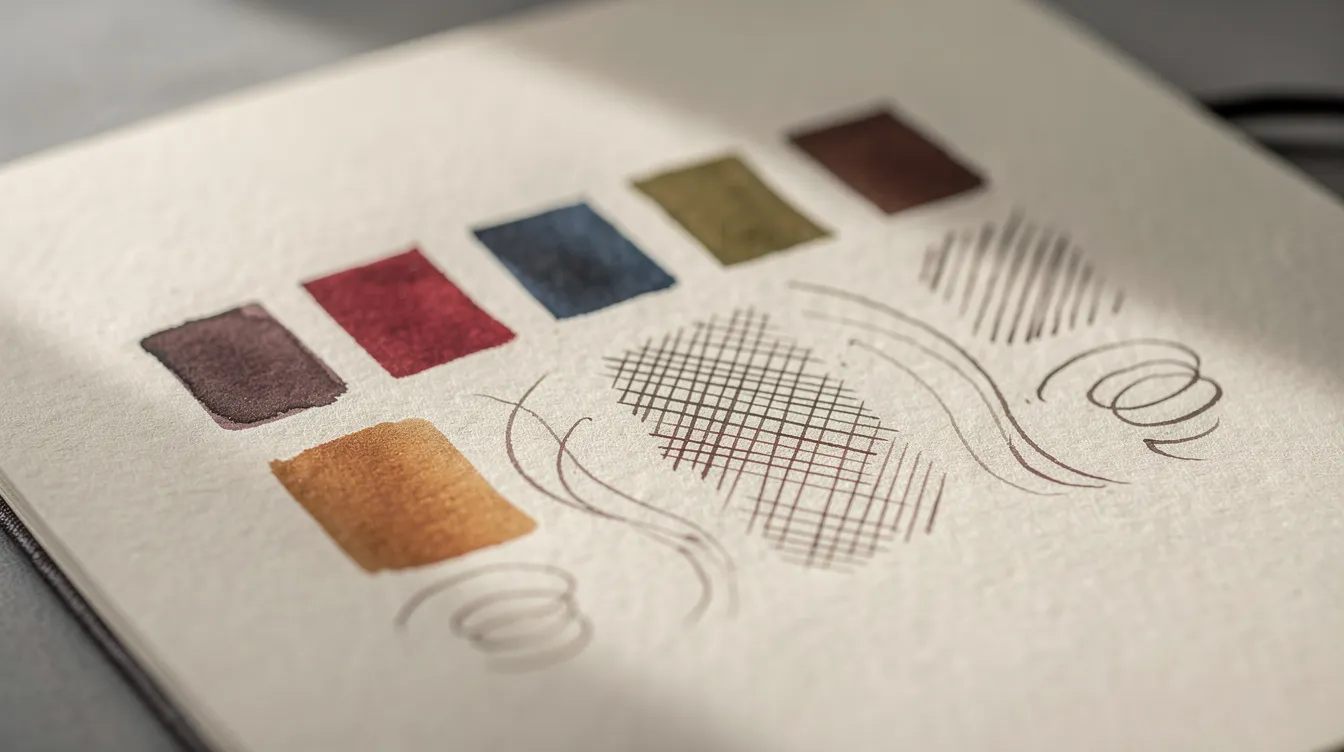
I do a five-minute test on the paper I actually sketch on. On one page I draw fine lines, cross hatching, a solid block, and I write the ink’s name beside each sample. Then I wait at least ten minutes.
After the ink dries I check show-through by flipping the page. I look at feathering, especially with a broader nib, because thin paper feathers and shows through badly. Smoother, sized paper keeps lines crisper. Choosing the right ink depends on its behaviour on paper and drying time, so I record the drying time beside each sample. Dry inks flow more slowly, helping to minimize feathering on cheap paper, which is worth knowing if your sketchbook is not premium stock.
Water Resistant Ink for Urban Sketching
Water resistant inks are designed to withstand moisture exposure, but there is a difference between water resistant and waterproof. Water resistant means some legibility remains after wetting. Waterproof means the line barely moves. Do not assume permanent performance from a label alone. Always test.
Pigment inks like Platinum Carbon Black contain fine solid particles that bond with paper fibres. Waterproof inks bond with paper for permanence unlike standard dye-based inks. Pigment-based inks offer exceptional archival quality and lightfastness, and pigment inks resist removal by solvents. But pigment inks require higher maintenance to prevent clogging, so I flush the pen more often.
Iron gall inks like Rohrer and Klingner Salix or Diamine Registrar’s Blue-Black look pale at first and darken as they dry. They are a nice match for brick and stone. Iron gall inks require diligent pen hygiene due to their acidic nature. The Wikipedia page for iron gall ink is worth reading if you want the history behind an ink that oxidizes on the page.
Dye-based “bulletproof” blacks such as some Noodler’s Ink formulations react with cellulose fibres and become water resistant once absorbed. Dye-based inks generally have low-to-medium water resistance, but these treated versions are an exception. Always test your lines before adding a wet wash. A drop of water on a dried sample page takes ten seconds and saves a sketch.
Fountain Pen Ink for Fast Sketches
Fast-paced note-taking benefits from dry or quick-drying dye inks, and the same applies to sketching in crowded public places. Most standard dye-based inks dry faster than heavily saturated colors, so a medium-saturation dye ink and a fine nib are a fast combination. On a bench, I rest my hand on the page constantly. A slow-drying ink means I drag wet lines with the side of my palm.
My ten-minute sketch test: I draw a quick building study, then immediately brush a finger across the lines. If ink lifts, I know I need to work differently with that ink, either by using a finer nib or by giving each area a few seconds before moving my hand across it. Fast drying inks with a fine nib are forgiving here.
Using Fountain Pen Ink With Watercolour
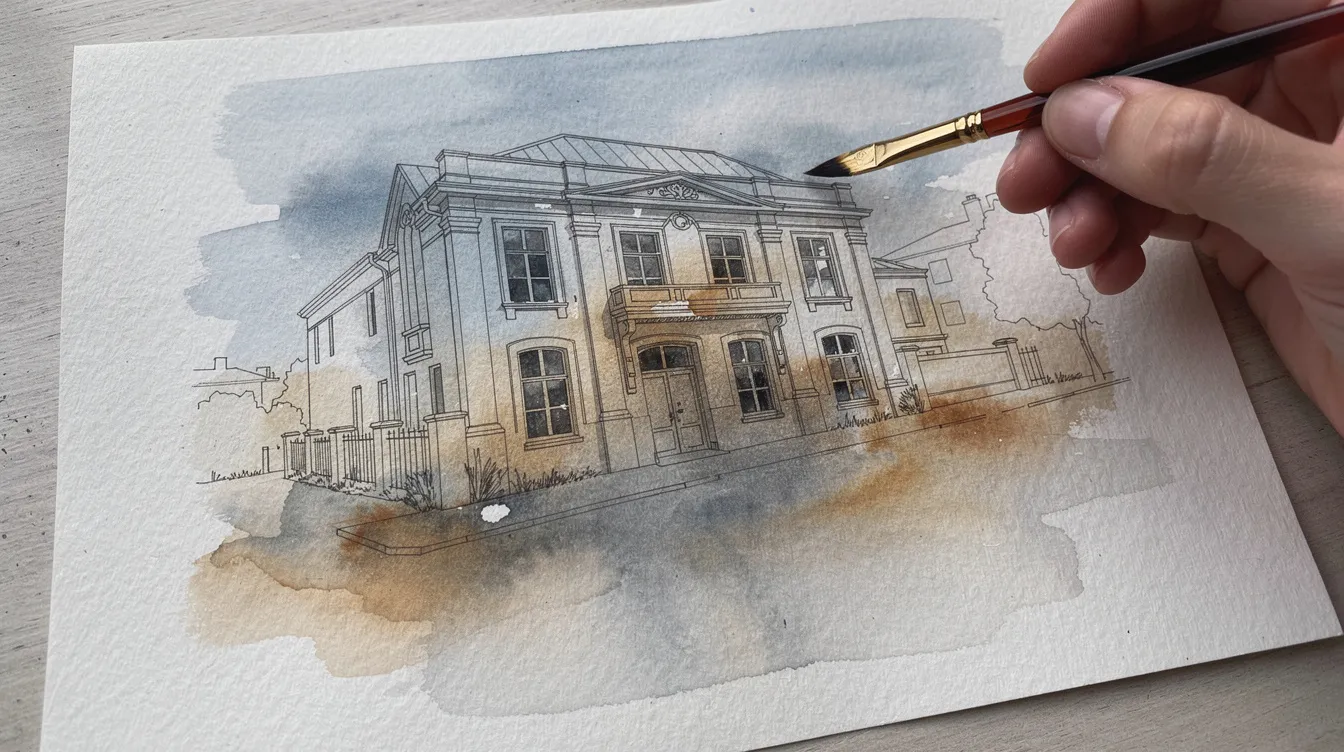
I layer watercolour over dry ink, waiting at least ten minutes and longer for heavy shading. The ink decides whether a wash looks crisp or turns into a grey puddle. Pigment and document inks hold their lines. Dye inks dissolve, which can be beautiful if intentional but devastating if not. If you are starting out with paints, see this guide to watercolour painting supplies.
Wet washes reveal weak lines. If a line was barely dry, the watercolour brush lifts it and spreads a ghost of colour around it. On cotton paper this is less severe because the fibres hold ink better, but I still wait.
Fountain Pen Ink for Buildings and Street Scenes
I match dark ink with strong architectural outlines at the front of a scene, and I use lighter colours or thinner lines for distant structures. Saturated ink goes on focal details: a doorway, a window, a sign. This creates depth without any perspective tricks.
Ink is unforgiving. You cannot erase a fountain pen line, so you learn to look longer before committing. That habit, looking before drawing, is the single most useful thing ink has taught me.
Fountain Pen Ink for Sketching People
For quick figure studies I use muted colours and fine lines. A dark brown or blue black is less jarring than pure black on a face. Bold black ink on a small gesture drawing can make a person look like a cartoon, so I keep it light.
Discreet public sketching matters to me. A quiet pen, a small sketchbook, and a muted ink help me draw people on a bench or in a cafe without making anyone uncomfortable.
Fountain Pen Ink for Trees and Park Benches
Brown ink suits rough tree trunks. I use short, broken lines for bark and a slightly broader nib for weight. Green ink goes on sparingly for foliage accents, a few marks rather than an attempt at every leaf. Grey ink handles bench shadows well, and I keep tree studies loose because a tight drawing of a tree looks stiff.
Choosing Fountain Pen Ink for Travel
I build a compact kit for day trips: one dependable pen filled with waterproof ink and one small bottle in case I need a refill. Bottles travel better when capped firmly, stored upright or wrapped in a cloth inside luggage. I keep the pen flat or nib up to avoid leaks. A single converter, a pocket sketchbook and nothing else. Availability of ink at your destination is never guaranteed, so I fill up before I leave.
Fountain Pen Ink for Trains and Buses
On a moving vehicle I want a controlled, quick-drying ink and a fine nib. Broad nibs lay down too much ink and every bump of the train turns into a blob. I sketch passengers with economical marks, just a few lines for a posture or a profile. I test pen balance before travelling because a heavy pen tires the hand quickly on a rocking bus.
Fountain Pen Ink in Rainy Weather
Rain weakens paper sizing and causes feathering even on good paper. Water resistant ink helps protect outlines during damp walks in Cork, which is most walks in Cork. I protect my sketchbook with a folded plastic bag or hold it under a doorway. After sketching in drizzle I dry wet pages before closing the book, because damp pages stick together and pull ink off each other.
Cleaning a Fountain Pen After Changing Ink
My routine is basic. When ink runs low or every few weeks, I flush the pen with clean water. Before switching ink families I flush until the water runs clear, because mixing inks from different formulations can react badly together. A cup of distilled water helps if tap water leaves deposits.
I check the nib after repeated fills. Sometimes dried pigments build up near the feed. If the nib writes scratchy or the flow drops, I soak the nib section in water overnight.
I keep a cheap pen for experimental inks. If something gums up, I have lost five euro rather than a favourite nib. Some secure inks are vulnerable to powerful infra-red lasers, which is an oddity I read about once and never worried about again, but it reminds me that ink chemistry is more complicated than it looks.
Avoiding Fountain Pen Ink Problems
Feathering on absorbent paper is the most common complaint from fountain pen users. If your paper feathers, try a drier ink or a finer nib before you blame the ink itself. Bleed-through limits page use because you lose the back of every sheet.
Watch for clogging after neglected fills, especially with pigment ink, which does better in a pen used regularly. Shimmer inks require special care as their particles can clog pens. Shimmer inks are infused with tiny metallic particles to create visual effects, and shimmer inks create a sparkling effect and are recommended for decorative writing, but I avoid them for everyday sketching because the maintenance is not worth it for me.
Dye inks can stain cotton fabrics permanently, so a tissue in your pocket saves a shirt. Stop using ink that behaves unpredictably, and carry a scrap of tissue so a wet thumb does not drag a line across a finished drawing.
Comparing Fountain Pen Inks Without Overbuying
Compare samples before choosing full bottles. Different ink brands are known for specific qualities and general quality assurance. Retailers like Goldspot offer a vast selection of fountain pen inks, and you can often browse a z alphabetically to find what you want. Prioritise inks you actually use during regular sketches, not inks you admire in a shop window.
Avoid collecting colours without a purpose. I keep a record of inks I finish, and that short list tells me what I really use. If a bottle sits untouched for six months, I give it away or use it for writing practice. The price of a full bottle of other inks from brands you never use adds up quickly. A collection of half-empty bottles on a shelf is not a sketching kit.
My Small Urban Sketching Ink Kit
My everyday kit: one fountain pen with a fine nib and waterproof black ink, one spare converter, and a pocket sketchbook. When I have room I add a tiny tin of twelve watercolour pans and a water brush. I have written up the rest of what I carry in my my notes on watercolor supplies. That is it.
A kit small enough to carry matters more than a perfect one. If the pen is in my jacket, I sketch. If it is at home, I do not.
Final Fountain Pen Ink Checklist
Before I leave the house:
-
Check ink flow by making a mark on scrap paper
-
Confirm paper suitability before sketching outdoors
-
Choose colour according to the scene: dark for outlines, mixed tones for atmosphere, a vibrant accent if needed
-
Pack a waterproof ink for watercolour work
-
Carry a tissue and a spare cartridge
The practical point is short enough to fit on the back of a hand. Pick a waterproof ink, test it on your paper, and start drawing. The world outside the door is full of things worth looking at. A fountain pen, a sketchbook and twenty minutes are enough.
FAQ
Is Platinum Carbon Black good for beginners?
Yes, if you use the pen regularly and flush it now and then. It is one of the best waterproof blacks available. But if you tend to leave pens untouched for weeks, a bulletproof dye ink like Noodler’s Black is less fussy because it does not form pigment deposits in the feed.
Can I use any fountain pen ink for sketching?
You can. Most ordinary inks work well for pure ink drawings. But most standard dye-based inks smear or lift under a wash, so if you plan to paint over your lines, test a waterproof ink first. Your results will stay legible.
How long should I wait before adding watercolour?
At least ten minutes, longer for heavy shading or a broad nib. A quick test on a scrap page tells you more than any rule. Touch the line with a damp finger. If it smears, wait.
Will waterproof ink ruin my fountain pen?
Not with regular use and rinsing. Try pigment and iron gall inks in an inexpensive pen first if you are nervous. The risk comes from neglect, not from the ink itself. A pen that sits filled with pigment ink for months without use is where problems form.
Do I need a special pen for sketching?
No. My first cheap pen still works. A reliable fine or medium nib is plenty. If the pen lets you draw without thinking about the pen, it is the right one. An orange cap or a silver clip or a gold nib do not make your sketches better. The street does that.